By Francesco Barilà Ciocca and Massimo Prearo | Full article available here (open access)
A review of the literature on legal and policy interventions at the European level on matters of gender and sexuality shows that two main approaches have emerged. If we consider policy paradigms as the way policymakers apprehend and frame the issues they address, and therefore the solutions they offer, we observe that institutions like the European Union and the Council of Europe initially operated according to an antidiscrimination paradigm. Throughout the years, a transition occurred towards an equality paradigm, in other words, while the initial preoccupation was to protect sexual and gender minorities from specific forms of discrimination (e.g. employment), the aspiration became to promote their equal rights in all areas of life. This paradigm shift at various European levels represents the backdrop to Italy’s development of policy instruments targeted at LGBTQIA+ people. We therefore wonder: how do these paradigms interact with the Italian context? How do LGBTQIA+ policies emerge in Italy and under what internal and external sources of pressure?
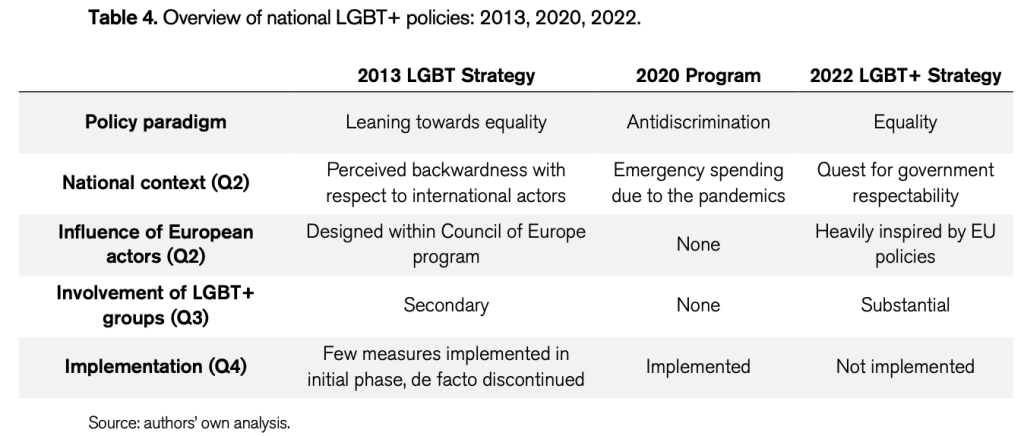
To answer to our research questions, we decided to look closely at the three LGBTQIA+ national strategies or programs that have existed in Italy from 2013 to 2022 and analyze a set of complementary documents that shed light on how these pieces of policy were politically and institutionally produced. From our analysis, we can draw three main conclusions.
1) While in Europe the notion of policy paradigm signals a trajectory where one set of representations supplants or integrates another, in Italy the two frameworks coexist simultaneously and seem to respond to different inputs. In situations that are perceived as urgent and emphasis is put on implementation, antidiscrimination appears as the established, readily available framework. By contrast, the equality paradigm fulfils a different function because it is mobilized as a more symbolic framework whose primary purpose is to respond to both endogenous (LGBT+ and anti-LGBT+ groups) and exogenous (European) pressure. Importantly, equality strategies have hardly or not at all been funded and implemented while the antidiscrimination one has been implemented. 2) We observe that the involvement (or lack thereof) of LGBTQIA+ actors makes a difference. In the design processes where they were included, the strategies follow an equality paradigm. Conversely, the plan that saw the light in isolation from LGBTQIA+ non-state actors falls neatly under the antidiscrimination paradigm.
3) European influence appears as decisive because the Italian policies that involved European actors or took heavy inspiration from EU policies skewed towards the equality paradigm, while the national strategy that only involved the Italian government clearly followed an antidiscrimination model.